 Svenska
About CAISR Health
CAISR Health is a research profile within information driven care at Halmstad University, where research on the development of AI tools meets research on how these tools can be implemented in healthcare.
CAISR Health is a cross disciplinary research profile, gathering research from two Schools at Halmstad University. The research is carried out in close collaboration with Region Halland, Ambea, Avenga, Capio, InterSystems, Mediqtech, Mölnlycke and Novartis and is funded by the Knowledge Foundation. The abbreviation CAISR stands for Centre for Applied Intelligent Systems Research, which is a research centre at Halmstad University that is strongly connected to the research profile.
Improving healthcare with AI
The availability of data is changing rapidly in healthcare. Descriptive data analytics and machine learning technologies will have a huge impact on healthcare operations in a near future. In Sweden, Region Halland was first to act on this and gather and successfully synchronise all their healthcare data and creating an organisation for using this data to improve healthcare operations. This has contributed to excellent results – over the last 4-5 years the healthcare system of Region Halland has shown a remarkable increase in efficiency while maintaining top level quality and access to care. Yet, there are challenges, and a key challenge is understanding implementation; what are best practices for creating impact with information-driven healthcare, to get solutions into the system and for changing how people work? There are also opportunities. The development with information driven care opens international business opportunities. Digital services can be developed for an international market, not just the national, and skills and methods can be exported (and imported). Global business investments in healthcare and IT are therefore growing quickly.
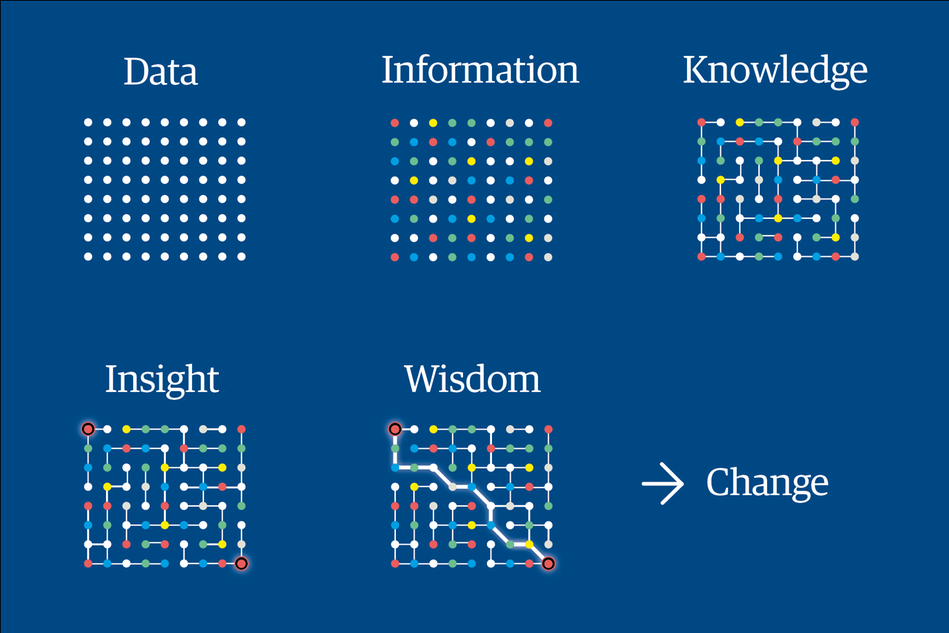
Information driven care: by learning from the conclusions of data analysis, change can be achieved.
Objective of CAISR Health
CAISR Health focuses on understanding the information driven healthcare system and build up knowledge about the whole chain – from formulating and prioritising questions, to developing algorithms, collecting data and enable engagement, explainability and implementation. To do this, CAISR Health works along four dimensions:
- Research
- Data infrastructure
- Industrial cooperation and innovation
- Education and increased competence
CAISR Health aids Region Halland in maintaining a leading position in Sweden, and our industry partners to be forerunners in information driven care infrastructure.
Subject areas
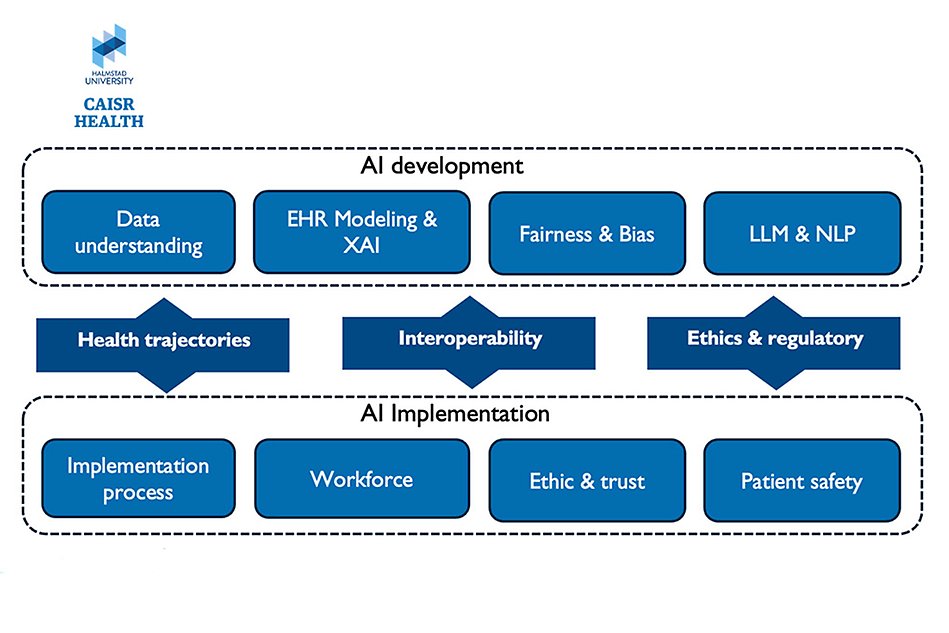
CAISR Health research focuses on two main areas: (1) AI development and (2) the implementation of AI in healthcare. Both areas rely on multidisciplinary perspectives to enable the responsible and effective use of AI, encompassing patient health trajectories, interoperability, and legal and ethical approaches. Our research analyzes longitudinal health and care data, as well as qualitative data from patients, professionals and organizations, to understand patient health trajectories and develop AI/ML models for earlier detection, personalized prevention, and improved treatment pathways, supporting the transition toward precision health. One of the central components of our work is implementation and integration of AI/ML in real-world health and social settings. We investigate barriers to interoperability by examining technical, organizational, and governance factors that affect the secure integration, sharing, and effective use of data across health and social care systems. In parallel, we study the practical implementation and evaluation of AI/ML systems within clinical and care workflows, identifying the infrastructural, institutional, and human factors that influence successful implementation. We also examine legal and ethical frameworks that enable the responsible use of sensitive health data and AI/ML systems, with particular attention to safeguarding patient privacy and autonomy.
AI development
The AI development research area focuses on advancing data understanding, temporal modeling of electronic health records (EHRs), and domain-specific explainable AI (XAI), while developing real-world validation frameworks to assess fairness and mitigate bias. We also investigate how the integration of large language models (LLMs) and natural language processing (NLP) can support reliable and scalable AI-driven insights in healthcare settings. Together, these efforts contribute to the development of AI/ML systems that improve healthcare delivery, respect patient rights, and promote equitable health outcomes.
AI development impact statement: The AI development research area advances reliable and reproducible AI-driven care tools, supports earlier and more accurate risk prediction, fosters transparency and accountability in clinical decision support, mitigates algorithmic bias and health inequities, and strengthens data governance while safeguarding patient privacy.
Data understanding
As AI becomes increasingly embedded in healthcare, we aim to develop scalable preprocessing and data harmonization pipelines to improve data quality and reproducibility. By enhancing data understanding, healthcare organizations can better manage heterogeneous, high-dimensional, and often fragmented data across systems, thereby strengthening the validity and robustness of analytics and AI/ML models.
Temporal modeling of electronic health records (EHRs) and explainable AI (XAI)
To enable earlier identification of health risks and support more personalized care, we develop advanced modeling approaches capable of capturing temporal dependencies and complex patient health trajectories. We emphasize responsible and explainable AI (XAI) to ensure that AI/ML models are not only high-performing and clinically accurate but also transparent, ethical, and aligned with patient-centered values.
Fairness and bias mitigation
Fairness is a central priority to prevent biases that could exacerbate existing health disparities. Our goal is to promote equitable model performance without compromising predictive accuracy. We systematically investigate how bias emerges throughout AI/ML pipelines and how to design methods to detect, quantify, and mitigate disparities across demographic and intersectional groups.
Advanced large language models (LLMs) and natural language processing (NLP)
By grounding generative AI in established clinical standards, we aim to enhance the reliability, scalability, and factual consistency of AI-driven insights. To enable interoperability and seamless integration across diverse healthcare systems, our approach leverages LLM support for mapping established healthcare data standards such as openEHR, FHIR, and the OMOP Common Data Model.
AI implementation
The AI implementation research area focuses on advancing the responsible implementation of AI in healthcare. By addressing challenges related to implementation, workforce transformation, ethics, trust, and patient safety, we contribute to effective, trustworthy, and sustainable AI integration that enhances patient outcomes across diverse healthcare settings.
AI implementation impact statement: The AI implementation research area investigates how AI/ML is applied in healthcare systems, its effects on the healthcare workforce, and the integration of ethical principles and trust in AI development, with the ultimate goal of enhancing patient safety.
Implementation process
Through case studies and collaborative research with healthcare partners, our research examines the implementation of AI in real-world healthcare systems. We investigate organizational, technical, and social factors that shape the adoption, integration, and clinical use of AI/ML, with particular attention to conditions that support scalable and effective implementation.
Healthcare workforce
AI is transforming professional roles and the organization of care. Our research investigates how AI impacts healthcare professionals’ responsibilities, competencies, and collaborative practices. We are also interested in how human-AI interaction shapes work practices, supports skill development, and influences the future of clinical work.
Ethics and trust
Our research examines how ethical considerations – including privacy, bias, transparency, and accountability – can be integrated into AI/ML development and implementation. We contribute to frameworks and best practices that enable responsible and ethical AI in healthcare settings. Trustworthy AI is critical for sustainable healthcare implementation.
Patient safety
Ensuring patient safety is central to the successful integration of AI in clinical settings. We examine how AI/ML tools support clinical decision-making and interact with care processes, identifying and managing potential risks related to AI use in healthcare. Our research aims to support the safe, reliable, and high-quality use of AI in healthcare.
published
Updated
share